
Why is emotional intelligence important for success?

Emotion is a complex experience of consciousness, bodily sensation, and behavior that reflects the personal significance of a thing, an event, or a state of affairs.

There are four emotions – happiness, sadness, fear, and anger.

Emotional intelligence (EI) or emotional quotient (EQ) is the ability to identify, assess, and control emotions. 

It exhibits abilities such as:

  • Identifying emotions;
  • Evaluating how others feel;
  • Controlling emotions;
  • Using emotions to facilitate social communication;
  • Relating to others.

When someone exhibits low measures of EQ, it can be behaviorally visible – 

  • Emotional outbursts,
  • Difficulty listening to others,
  • Becoming argumentative,
  • Blaming others,
  • Overly sensitive,
  • Difficulty maintaining relationships
  • Stonewalling.

EQ is a better indicator of success in the workplace and is used to identify leaders, good team players, and people who best work by themselves.

According to research, perseverance, self-control, and skill in getting along with others influences success. Individuals with strong leadership potential also tend to be more emotionally intelligent.

Workers with high EQ are better able to work in teams, adjust to change, and be flexible. As the workplace continuously evolves, making room for new technologies and innovations, these qualities may become increasingly important.
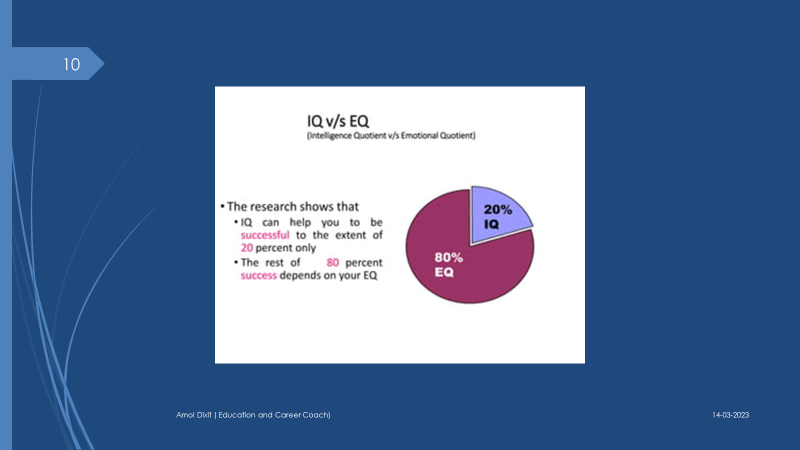
It accounts for 27 to 45 percent of job success as it enhances the following traits in you:

  • Self-awareness: It helps to understand strengths and weaknesses.
  • Self-regulation: A person with a high EQ can maturely reveal emotions and exercise restraint when needed.
  • Motivation: Emotionally intelligent people are self-motivated.
  • Empathy: A person who has compassion and an understanding of human nature that allows them to connect with other people on an emotional level.
  • People skills: Emotionally intelligent people can build rapport and trust quickly with others. They usually have respect for others around them.

We have conducted online and offline sessions on emotional intelligence for individuals and groups.

High EQ will get you through life.

Emotional Intelligence and Success Coach

Soft skills training

Soft skills tend to be more personality-focused, which includes things like people skills, social skills, interpersonal skills, and transferable skills. They are general traits that help an individual to excel in the workplace and life. 

Soft skills for success in career and life are communication, emotional intelligence, adaptability, problem-solving, critical thinking, leadership, teamwork, collaboration, and time management.

Benefits of soft skills training:

  1. Behavioral development;
  2. Personality development;
  3. Building personal and professional relationships;
  4. Increased productivity;
  5. Effective collaboration;
  6. Enhanced emotional intelligence;
  7. High-level empathy
  8. Innovative and creative approaches.

Studies indicate that soft skills account for roughly 80% of a person’s success throughout their career. 

Soft skills training helps to learn and improve non-technical or personal skills. These involve interaction with others, including communicating effectively, collaborating with team members, being flexible, and understanding and managing emotions. 

Soft skills training helps individuals manage teams effectively, delegate tasks efficiently, and build positive relationships, ultimately enabling them to become more effective and efficient leaders. Soft skills training is training that focuses on the development of abilities such as communication, teamwork, and problem-solving. Other soft skills include emotional intelligence, a positive attitude, and taking the initiative. It has to be learner-centered, enabling participants to interact, connect, and reflect.

A soft skills trainer is a professional who provides education regarding the art of business communication and relationships. They might work for an individual company or as a consultant. A soft skill trainer provides training to participants and helps them strengthen their interpersonal skills. 

Being passionate is highly desirable for trainers. They should know how to maintain a passion for their work, keep their heart and minds open, and deeply care about their training. An effective trainer genuinely cares about learners’ success. The trainer should be an effective speaker with good interpersonal and teamwork skills to convey his thoughts. A trainer’s role is to build an environment that stimulates learning and growth for participants.

There are several options for delivering soft skills development training:

  1. Gamification
  2. Story-based learning
  3. Small conversations
  4. Role-plays
  5. Scenario-based Learning
  6. Role-Modeling and Mentoring
  7. Develop a learning mindset
  8. Encourage self-reflection
  9. Peer Learning and Collaboration
  10. Feedback

To date, I have trained almost 9,000 participants. My experience at different levels in various fields helped me to understand my participants, thus fostering a positive environment for my participants. It developed a learning environment for my participants to express themselves positively and effectively. Interactive sessions helped my participants to connect with themselves and others. My training sessions have helped participants develop personally and professionally. The positive results of training and placement have benefitted many institutes in getting accreditations.

I am proud to announce that most of my participants have achieved their career and life goals.

I wish a happy and prosperous life for all my participants.

All the best !!!

Happiness leads to Success !

Everyone thinks that if they become successful then they will be happy.

✘ Success -> Happiness

But, unfortunately it is not so. Instead it follows a below mentioned order :

✓ Happiness -> Prosperity -> Success 😊

You first need to be Happy to be truly Successful.

So be Happy if want to be Successful !